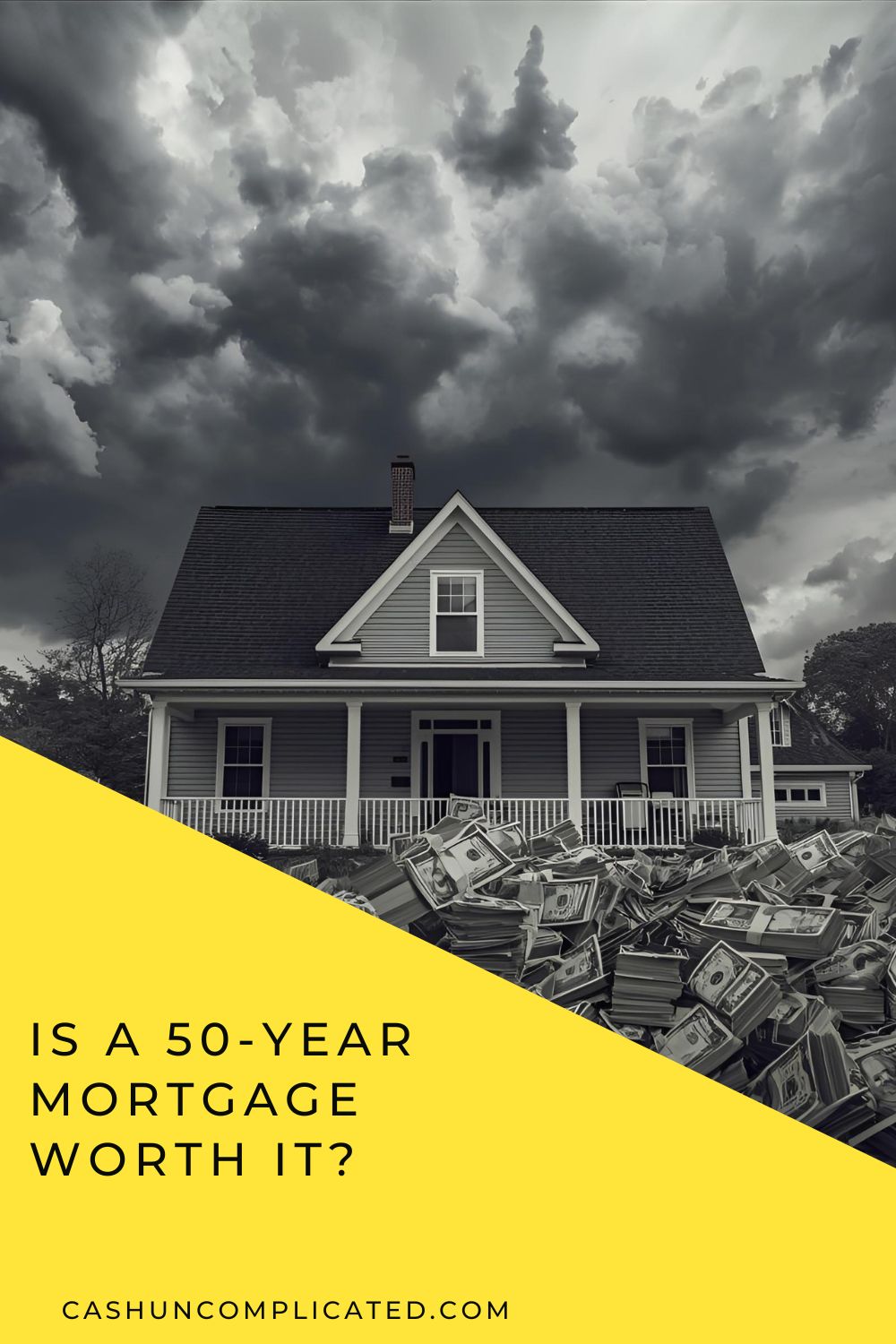
The idea of a 50-year mortgage has been tossed around over the past couple weeks. 50 years to pay off a house instead of the usual 15 or 30 years. After factoring everything in, is it worth it?
Let’s use an even number of a $500,000 loan with a six percent interest rate. That cost is higher than the national average, but much lower than the median home in most of the coastal states.
50-Year Mortgage Payoff
For a 50-year mortgage, the monthly principal and interest payment would be $2,632. After year one, the homeowner would be paying $29,956 in interest and $1,629 towards the principal. Not much progress over a year but they’re in the house.
Here are the numbers for years 5,10, 20, 30, 40, and 50:
| Year | Interest Paid | Principal | Loan Balance |
| 5 | $29,515.18 | $2,069.11 | $490,788.68 |
| 10 | $28,793.37 | $2,790.91 | $478,364.27 |
| 20 | $26,506.51 | $5,077.78 | $438,999.53 |
| 30 | $22,345.79 | $9,238.50 | $367,379.94 |
| 40 | $14,775.80 | $16,8098.49 | $237,075.49 |
| 50 | $1,002.98 | $30,581.31 | $0 |
30-Year Mortgage Payoff

For a 30-year mortgage, the monthly principal and interest payment would be $2,998. After year one, the homeowner would be paying $29,833 in interest and $6,140 towards the principal.
Here are the numbers for year 5,10, 20, and 30:
| Year | Interest Paid | Principal | Loan Balance |
| 5 | $28,172.15 | $7,800.88 | $465,271.78 |
| 10 | $25,450.82 | $10,522.22 | $418,428.62 |
| 20 | $16,828.95 | $19,144.08 | $270,017.93 |
| 30 | $1,142.35 | $34,830.68 | $0 |
Total Interest Paid
Assuming the borrower kept the loan the whole time, the total interest paid on a 50-year mortgage would be $1,079,214.. On a 30-year loan it would be $579,191.
The difference between the two loans is $500,023 dollars. On the surface, that’s almost double the amount of money, case closed that the 30-year loan is better, right?
Maybe, but not so fast.
Investing the Difference

What if the borrower with the 50-year mortgage invested the monthly difference to what he or she would have been paying with the 30-year mortgage? $2,998 minus $2,632 is a difference of $366 every month.
Assuming a 10 percent return, $366 invested monthly for 50 years equals $5,623,075. Compare that to the 30 year loan where no money is invested for 30 years, but once the loan is paid off, this person can invest $2,998 for the next 20 years.
Using the same 10 percent rate of return, that equals $2,266,578.
Here are the final numbers:
- Difference between 50-year loan and 30-year loan: $500,023
- Investing for 20 years after the 30-year loan is paid off: $2,266,578
- Total: $2,766,601
- Investing the difference for 50 years: $5,623,075
- $5,623,075 minus $2,766,601: $2,856,474
- Grand total: $2,856,474 in favor of the 50-year loan
So the person who got the 50 year-loan would end up with $2,856,474 more than the person who got the 30-year mortgage under this scenario.
The Variables
This analysis has been a straight comparison of the 30 and 50-year mortgages. The reality though is there are an endless amount of variables such as:
- If the person sells the property well before the end of the loan
- Market conditions in the first 10 years of the loan
- People who use the 50-year loan to qualify for more house than they would have purchased using a 30-year loan
- Interest rate discrepancies between the two loans (the 50 is likely to be higher)
- Are most people really going to live in the same house for 50 years?
- The returns on investments aren’t guaranteed like the return of paying off the loan
- Any investment return under six percent completely blows up this scenario
- 50 years is a really long time. In the case of a 30-year old, the mortgagee would be 80 years old before the house is paid off.
What Should You Do?
There are arguments both ways but my gut instinct is to avoid the 50-year mortgage. I think it’s way too many years of debt and the great majority of people aren’t going to invest the difference every single year.
I also think too many people are going to just increase the amount they qualify for, buy too much house, and end up not investing any kind of difference.
Debt and leverage using a 50-year loan is a double edged sword, and I think in the case of the 50-year mortgage, the sword is way too sharp for most people, including myself.
Would you get a 50-year mortgage?